
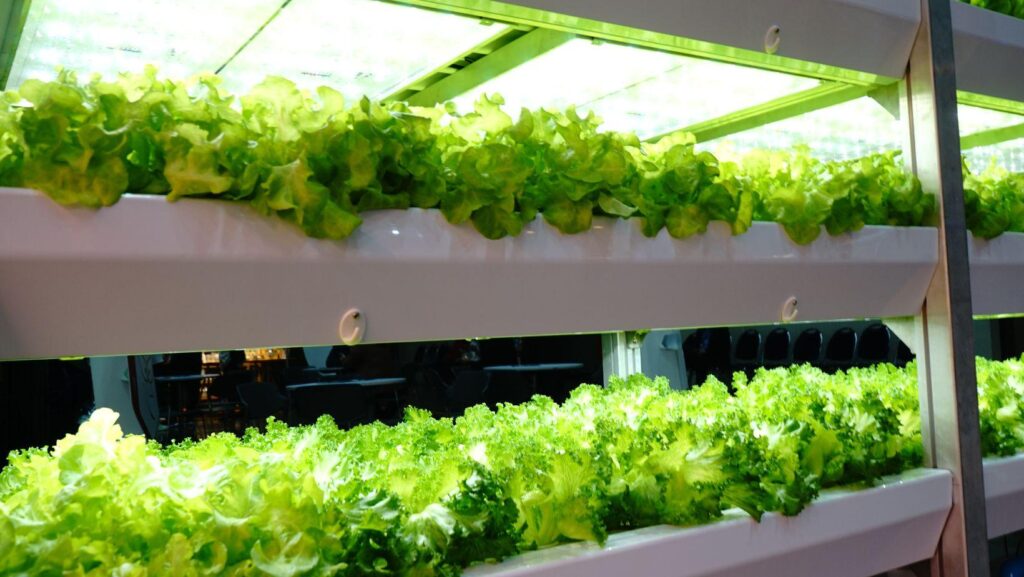
As global food demand rises, urban land grows scarce, and climate shifts disrupt traditional agriculture, indoor vertical farming has emerged as a promising alternative to field farming. By stacking crops vertically in controlled indoor facilities, vertical farms grow food year-round using a fraction of the land and water required by outdoor farms.
However, replacing sunlight, rain, and soil with technology requires a complex engineering stack and significant capital investment. While vertical farms produce high crop yields in small footprints, building a profitable operational model requires carefully balancing high energy bills, automated labor costs, and crop selection.
Controlled Environment Agriculture and Automated Lighting
Vertical farming relies on Controlled Environment Agriculture (CEA), where every growing variable—light, temperature, humidity, carbon dioxide levels, and nutrient delivery—is monitored and adjusted using sensors and automated systems.
Plants grow on multi-tiered racks housed inside climate-controlled warehouses. Instead of sunlight, vertical farms use energy-efficient LED fixtures that emit custom “light recipes.” Engineers tailor light wavelengths, mixing specific ratios of red, blue, and far-red spectrums, to optimize photosynthesis and speed up plant growth.
Whether monitoring crop growth cycles from a control room, analyzing water quality metrics, or checking facility updates on a phone while taking a quick break to visit a 7bet UK site, growers rely on continuous data collection to keep their indoor crops healthy.
|
Vertical Farming Component |
Technology Used |
Primary Agricultural Benefit |
|
Spectral LED Lighting |
Custom red/blue light recipes |
Accelerates growth cycles and boosts plant yield per square foot |
|
Hydroponic / Aeroponic Systems |
Recirculating water and nutrient misting |
Uses up to 95% less water than traditional soil-based farming |
|
HVAC Climate Dehumidification |
Industrial heat pumps and air scrubbers |
Recovers plant transpiration water to keep indoor humidity balanced |
|
Automated Harvesting Robotics |
Robotic arms and automated conveyor belts |
Lowers manual labor costs for seeding, moving, and harvesting crops |
Closed-Loop Irrigation and Nutrient Delivery
Soil-based farming loses vast amounts of water to evaporation and soil run-off. Vertical farms use closed-loop irrigation systems, such as hydroponics (growing roots in nutrient-rich water) or aeroponics (misting bare plant roots with nutrient solutions).
Because irrigation water circulates through closed pipes, vertical farms consume up to 95% less water than traditional farms. Furthermore, HVAC systems capture moisture evaporated by plant leaves, condense it back into liquid water, and feed it straight back into the irrigation system. This enclosed approach also eliminates agricultural run-off, protecting local rivers and groundwater from fertilizer pollution.
The Economic Challenge of High Fixed and Operating Costs
While the technological benefits of indoor farming are clear, the economic model presents significant financial hurdles for farm operators.
- High Capital Expenditures (CapEx): Outfitting a warehouse with automated LED racks, industrial HVAC units, robotics, and water treatment systems costs millions of dollars before the first seed is planted.
- Heavy Electricity Costs (OpEx): Running thousands of high-intensity LED grow lights and industrial climate control units 16 to 20 hours a day generates massive utility bills, making power consumption the single largest operational expense.
- Narrow Crop Variety: Because of high energy costs, vertical farms currently focus almost exclusively on fast-growing, high-margin crops with high water content, such as leafy greens, microgreens, herbs, and strawberries. Calorie-dense staple crops like wheat, corn, and potatoes remain economically unviable to grow indoors.
The Future Outlook of Urban Agriculture
Vertical farming is not meant to replace traditional outdoor agriculture entirely, but rather to complement it near dense urban centers. By locating farms inside or near major cities, growers cut supply chain transit times, eliminate long-haul trucking emissions, and deliver fresh, pesticide-free produce to grocery shelves within hours of harvest.
As LED efficiency improves, automation costs drop, and renewable energy becomes more accessible, the economics of indoor agriculture will continue to improve. Blending advanced indoor technology with sustainable practices ensures vertical farms will play a vital role in securing fresh food for the world’s growing cities.