
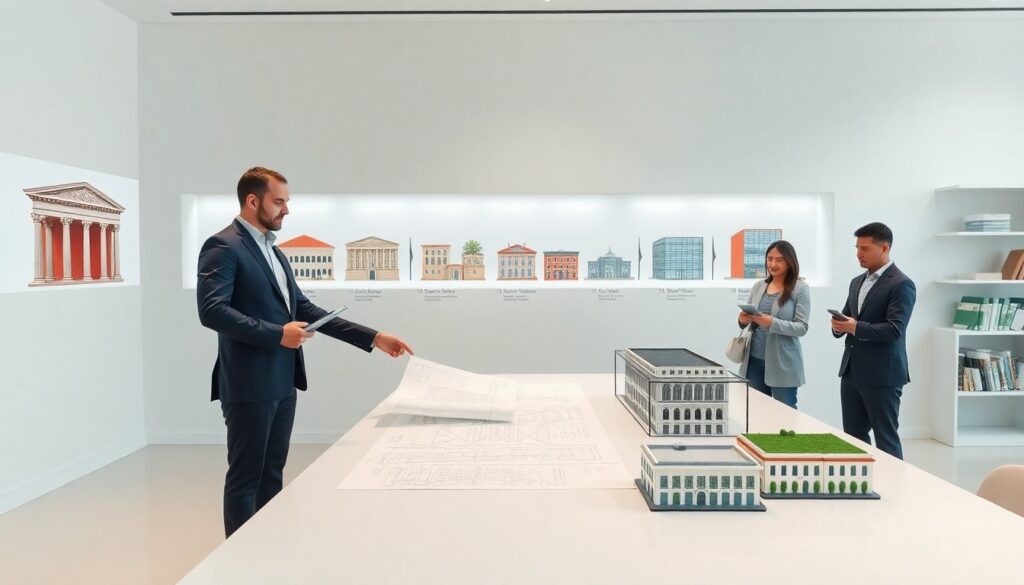
The timeline of architectural styles guides readers through major design shifts over centuries. It maps how societies built temples, churches, palaces, factories, and homes. This guide lists key styles, dates, and defining features. It helps readers spot classical columns, Gothic arches, Baroque curves, Modernist planes, and current sustainable approaches. The timeline of architectural styles appears below in three clear eras for quick reference.
Key Takeaways
- The timeline of architectural styles maps major design shifts from Ancient times to today, highlighting classical columns, Gothic arches, Baroque curves, Modernist planes, and sustainable design.
- Ancient through Medieval styles established foundational forms like symmetry, arches, and vaulted ceilings that influenced religious and civic architecture.
- From the Renaissance through the 19th century, architecture revived classical principles and embraced dramatic Baroque curves, Neoclassical restraint, and eclectic historicism alongside new industrial materials.
- The 20th century brought Modernism’s minimalism and technical clarity, followed by Postmodernism’s playful ornamentation, leading to today’s contemporary blend of digital tools and varied forms.
- Sustainable architecture has become central recently, focusing on energy efficiency, recyclable materials, and environmental responsibility to shape future building design.
- Understanding this timeline helps identify architectural features in cities and connects them to historical, cultural, and technological contexts.
Ancient Through Medieval: Classical, Byzantine, Romanesque, And Gothic
Ancient architects used stone, proportion, and symmetry. Greek designers placed columns and pediments in temples. Roman builders added arches, vaults, and concrete. The classical language set rules for form and civic scale. The timeline of architectural styles begins with these classical rules.
Byzantine architects kept classical form and added domes and mosaic surfaces. They used pendentives to set round domes on square bases. Hagia Sophia in Istanbul shows their structure and surface art. The Byzantine phase emphasized interior light and iconography.
Romanesque builders returned to thick walls and rounded arches. They used small windows and heavy piers to support barrel vaults. Monasteries and pilgrimage churches in Europe show Romanesque solidity. This style aimed for protection and durable liturgical space.
Gothic architects shifted to height and light. They used pointed arches, ribbed vaults, and flying buttresses. These devices moved weight to external supports and freed walls for stained glass. Cathedrals such as Chartres and Reims show vertical emphasis and narrative windows. The Gothic phase marks the timeline of architectural styles move toward expressive structure.
In this era, design served ritual, defense, and civic pride. Craftsmen and guilds refined stone carving, stained glass, and timber roofs. Regional variations appeared, yet the timeline of architectural styles kept a clear path from classical order to Gothic verticality.
Renaissance To The 19th Century: Renaissance, Baroque, Neoclassical, And Eclectic Movements
The Renaissance revived classical proportion and human scale. Architects studied Roman ruins and treatises. They placed symmetry, clear geometry, and harmonious orders at the center. Buildings such as St. Peter’s used domes, pilasters, and measured facades. The timeline of architectural styles shows a return to rational form.
Baroque designers added emotion and movement. They used curves, grand staircases, and dramatic light to create theatrical space. Palaces and churches expressed power through scale and ornament. Baroque gardens extended architectural drama into the landscape.
Neoclassical architects reacted to Baroque excess. They returned to strict classical language and reduced ornament. Public buildings adopted temple fronts, columns, and pediments to convey civic virtue. The timeline of architectural styles records Neoclassicism as a civic and institutional mode.
The 19th century produced revival and eclecticism. Architects mixed Gothic, Renaissance, and classical motifs. Industrial materials such as iron and glass entered building practice. The Crystal Palace in London exemplified new structural approaches. Eclectic movements gave architects freedom to select historical references for function and image. The timeline of architectural styles shows this period as one of reinterpretation and technical change.
During these centuries, patrons, academies, and advancing construction methods shaped visual priorities. The timeline of architectural styles reflects shifts in taste, politics, and technology across Europe and colonial territories.
20th Century To Today: Modernism, Postmodernism, Contemporary, And Sustainable Design
Modernism broke from historical reference. Architects such as Le Corbusier and Mies van der Rohe promoted function, structure, and minimal ornament. They used reinforced concrete, steel, and glass. The International Style favored flat planes, open plans, and regular facades. The timeline of architectural styles marks Modernism as a move to clarity and technical honesty.
Postmodernism reacted to Modernist austerity. Designers reintroduced ornament, color, and historical quotation. They played with scale and irony to craft memorable civic and commercial buildings. Postmodern works asked users to read symbolism and context rather than accept universal form.
Contemporary architecture blends ideas. It uses digital tools, parametric forms, and new materials. Architects mix transparency, texture, and massing to meet program and site. The timeline of architectural styles now includes varied approaches and cross-disciplinary teams.
Sustainable design appears as a core concern in recent decades. Practitioners focus on energy, materials, and lifecycle impact. Strategies include passive heating, green roofs, photovoltaic integration, and recyclable materials. Cities adopt codes that reward efficiency and resilience. The timeline of architectural styles hence shifts from formal categories to performance criteria.
Globalization and technology shape current work. Architects collaborate across borders and use modeling to test structure and energy. The timeline of architectural styles shows continuity in concern for proportion and new focus on environmental responsibility. Today’s buildings often combine formal clarity with measurable performance goals.
Readers can use this concise timeline of architectural styles to recognize features in their city. They can link a column, arch, dome, or curtain wall to a broader historical moment. The timeline of architectural styles remains a practical tool for study and design appreciation.