

Renovation problems often begin before a contractor arrives on site. A client approves a plan, selects finishes, agrees to a layout, and still feels surprised when the room begins to look real. The issue usually does not come from poor effort by the architect or designer. It comes from a client approving something they do not yet fully see.
That problem has always sat at the center of home renovation planning. Architects work through plans, sections, elevations, samples, and spatial logic. Clients think in lived experience: how the room will feel, how light will move, where furniture will sit, and how the space will work on an ordinary day.
Architectural visualization has long helped translate design intent into visible form, but older workflows often required specialist time and larger budgets. AI visualization now gives architects, designers, and homeowners a faster way to compare design directions while decisions are still easy to change.
The Visualization Gap in Home Renovation Planning
Early renovation decisions often rely on abstract materials. A floor plan explains circulation. An elevation explains wall treatment. A finish board explains color and texture. These materials make sense to trained professionals because they read drawings as spatial information. Many clients read them as fragments.
That difference matters in home renovation planning. A client may understand that the kitchen will open into the dining area, or that a bedroom will gain new storage, but still fail to grasp the final feeling of the room. Scale, depth, sightlines, furniture size, and natural light all affect the result. Drawings describe those issues, but many clients do not experience them clearly until construction has already begun.
This creates a costly pattern. The client signs off because the plan seems reasonable. Later, the built work reveals a mismatch: the room feels smaller, the finish feels colder, the furniture path feels tight, or the open layout does not suit daily habits. At that point, a design adjustment becomes a change order, a delay, and an added cost.
The old advice still applies: measure twice, cut once. In renovation work, that means clients need a clear visual understanding before the first cut happens.
How AI Has Changed What Is Possible Before Construction Begins
Traditional architectural visualization already solved part of this problem. A high-quality 3D render gives clients a detailed view of a redesigned space with realistic materials, lighting, furniture, and depth. For large residential projects and commercial interiors, that level of production still has a firm place.
The barrier has always been practical. Professional renders require modeling, material setup, lighting work, review rounds, and specialist production time, while each revision adds more work. That process suits major projects, but it often feels too heavy for early renovation discussions, smaller rooms, or quick design comparisons.
AI visualization adds a lighter communication layer to home renovation planning. Instead of modeling every view from the ground up, a user starts with a photo of the existing room and creates a realistic concept view during the early review stage. The output does not replace technical documentation. It does not confirm exact dimensions, structure, code compliance, or buildability. Its value sits in a narrower but useful place: it helps people see a design direction early enough to discuss it properly.
This is where ai room visualization enters the renovation process. It gives clients a visual reference before they commit to costly work. It also gives architects and designers a quicker way to learn how a proposed direction lands with the person who will use the finished space every day.
Virtual Staging as an Entry Point Into the AI Visualization Workflow
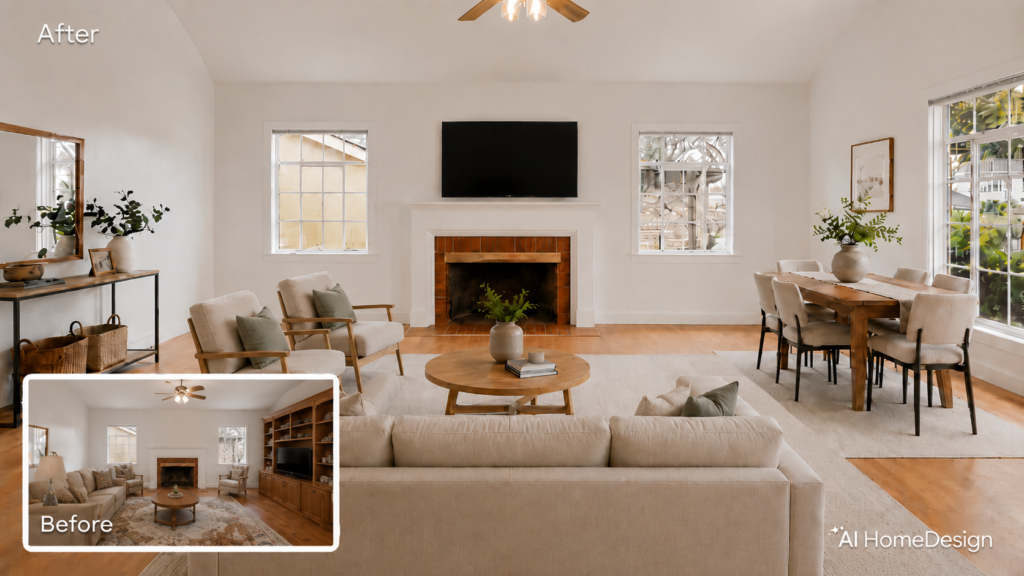
Among AI tools in the renovation process, virtual staging offers one of the simplest entry points. It does not require BIM training, 3D modeling skill, or rendering software. The workflow is direct: upload a room photo, choose a design direction, and create a furnished view of the space.
That simplicity has real value in home renovation planning. Early client questions often start with feeling, not technical detail. Does the room feel balanced? Does the seating area make sense? Does the furniture plan match the way the client wants to use the space?
Virtual staging ai for architects helps designers show a furnished version of a room during early renovation discussions, before every idea requires detailed modeling or technical documentation.
Virtual staging does not replace design judgment; it makes design intent easier to discuss. Plans often make opened walls, revised seating zones, or new bedroom layouts hard for clients to read. A staged view of the same room gives the discussion a clear visual reference. With ai room visualization, homeowners bring sharper preferences to the architect, while the architect still owns structure, code, circulation, materials, and cost.
The Impact on Client Approvals and Project Outcomes
A visualization-first workflow changes the approval conversation. The question moves from, “Does this plan make sense?” to, “Does this space look and feel close to the expected result?” That shift moves approval from abstract agreement to shared visual understanding.
Home renovation planning benefits because disagreements appear at a cheaper stage. A client rejects a style, questions a layout, or asks for a different room function before contractors schedule work and before suppliers receive material orders. Changing a concept image costs far less than changing a built wall.
Clearer visuals also improve decision speed. Clients who hesitate over drawings often respond more directly to images. They compare options, discuss trade-offs, and understand consequences with less mental translation. Professional judgment still leads the process, but AI visualization gives that judgment a stronger communication layer.
What AI Visualization Does Not Replace
AI visualization has certain limits. It does not replace architectural expertise, structural judgment, material specification, building codes, site analysis, or construction documentation. It cannot determine whether a wall is load-bearing, confirm that a layout meets local rules, or prove that a finish will perform the same way in real light, humidity, or long-term use.
A convincing image sometimes shows an idea that costs too much, breaks code, blocks circulation, or ignores site conditions. Architects and designers must treat AI output as a communication tool, not a final design authority.
Professional architectural visualization will also remain important for projects that need accurate geometry, complex lighting studies, exact material behavior, or formal presentation images. AI visualization works best at the concept and client communication stage. It helps people see direction, compare choices, and reach shared understanding. It does not serve as the technical record of the project.
When teams use ai room visualization properly, it strengthens the architect’s role. It helps clients see what the architect means. It gives homeowners better language for feedback. It reduces the chance that a major approval rests on incomplete understanding.
The best renovation outcomes come from clear decisions made early. For home renovation planning, AI visualization now offers a practical bridge between design intent and client perception. It does not replace expertise. It makes that expertise easier to see, discuss, and approve before work begins.